
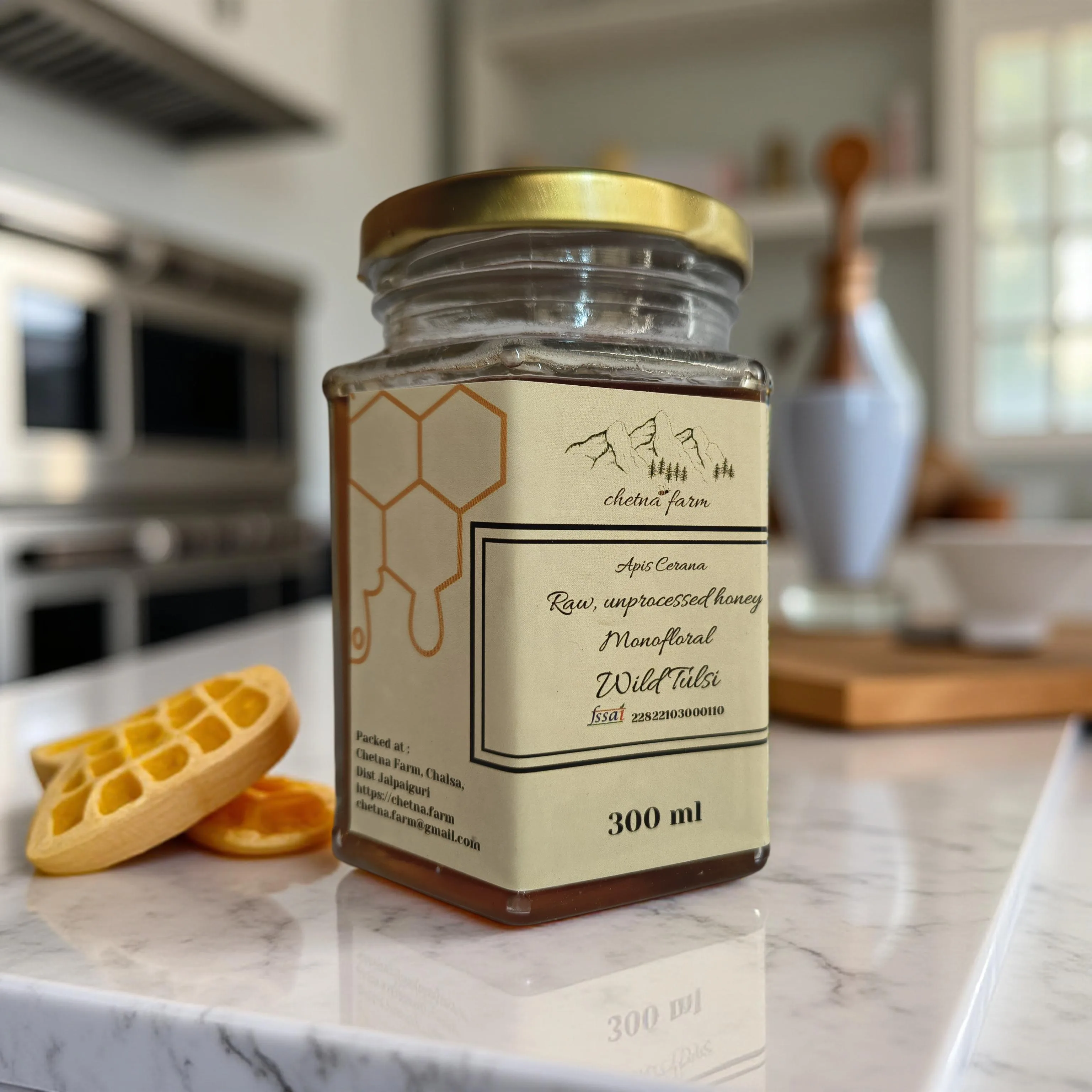
Indigenous Honey.
From Apis cerana — the native Indian honey bee, smaller than the European species and adapted to the flowers of these foothills. Each flavour is a different bloom period. Extracted by hand, strained once through muslin. No heating.
Order via WhatsApp. We confirm stock and share payment details within a few hours.
What makes Apis cerana different
Most commercial honey in India comes from Apis mellifera — the European honeybee, introduced here in the 1960s for industrial-scale production. Apis cerana is the original. Smaller hives, smaller frames, lower honey yield per colony. But the flavour is distinct: more complex, more aromatic, tied directly to whatever the bees are foraging at a given time of year.
The bees at Chetna Farm forage across the farm's kitchen garden, the surrounding forest margin, and the fields of Chalsa. The flora shifts with the season — which is why the honey shifts with it. Wild tulsi in September. Jamun in June. Litchi and mango in spring. Each batch is a record of what was flowering.
How it is harvested
We harvest the surplus honey from the super chamber — the upper section of the hive where bees store honey beyond what the colony needs. The super is removed carefully, the honey extracted by hand, strained once through muslin cloth, and poured directly into jars. No centrifuge. No heating. This preserves the pollen, the enzymes, and the volatile aromatic compounds that disappear when honey is warmed.
Natural honey granulates over time. This is normal — it means the honey has not been heat-treated. To re-liquefy, sit the jar in warm (not hot) water for 20 minutes.