
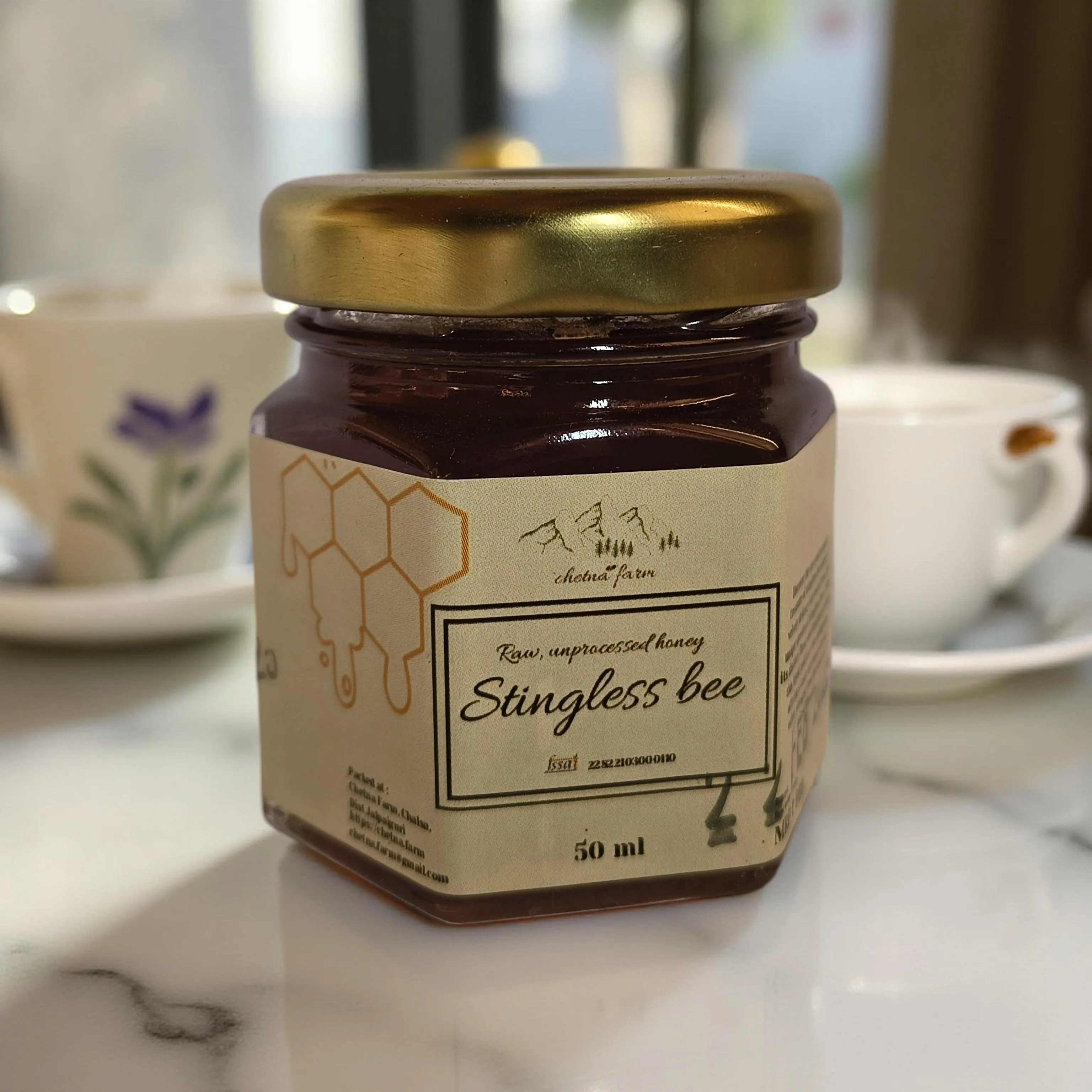
Stingless Bee Honey.
From Tetragonula iridipennis — the indigenous stingless bee, kept in log hives at Chetna Farm the way they have been kept in this region for generations. Naturally acidic. A single colony produces around 500g per year.
Stock is limited — one harvest per year per colony. We confirm within a few hours and share payment details.
One of the rarest honeys in the world
Stingless bees (Tetragonula iridipennis, known locally as putka) build their colonies inside hollow logs and tree cavities. They do not sting. They are ancient pollinators — present in this region long before the European honeybee arrived. In the Nepali-speaking communities of North Bengal and Sikkim, this honey is called putka ko mau — honey of the putka — and has been gathered from the forest for generations.
Their honey is unlike Apis honey in almost every way. Lower sugar content. Higher water content. Naturally acidic — pH around 3.5. It does not granulate. The flavour is more complex: floral, slightly sour, with a finish that stays. A growing body of peer-reviewed research — particularly from Southeast Asia and South Asia — documents its antimicrobial and antioxidant properties. It has been used medicinally in Ayurveda and indigenous practice for centuries. We make no claims; the papers are available.
Why the quantity is so small
Production is constrained by nature. A single stingless bee colony produces around 500g of honey per year — compared to 20–30kg from an Apis mellifera hive. Chetna Farm maintains multiple colonies in traditional log hives, and each batch is harvested by hand once a year. Some years a colony produces less. There is no way to increase the yield without harming the colony.
This is why availability is limited and why it is sold in 50g jars. If you are looking for a large quantity, we will almost certainly not be able to help.